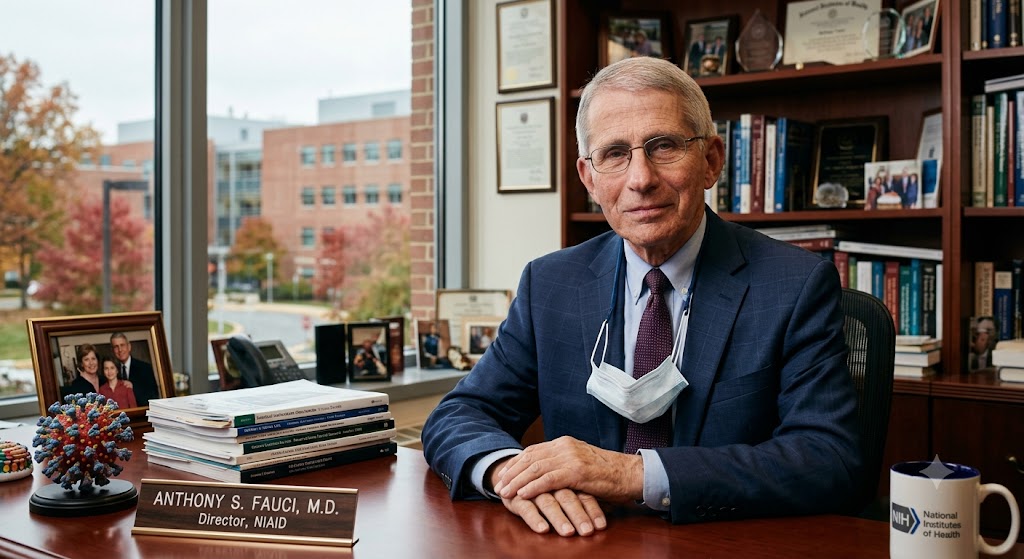
THE DARK SIDE OF THE HISTORY OF FAUCI
BOOK: THE REAL ANTHONY FAUCI:https://amzn.to/3RWJx3K
(Amazon Affiliate)
Throughout his 54-year career at the National Institutes of Health (NIH), Dr. Anthony Fauci was one of the most influential figures in global public health. However, as the long-time Director of the National Institute of Allergy and Infectious Diseases (NIAID) from 1984 to 2022, his decisions, public communications, and institutional oversight generated significant debate, pushback, and criticism across multiple decades.
The primary public controversies, policy criticisms, and points of contention surrounding Dr. Fauci’s career span five key areas:
1. The Early HIV/AIDS Crisis (1980s)
During the onset of the HIV/AIDS epidemic in the 1980s, Fauci became a target of intense criticism from LGBTQ+ advocacy groups and AIDS activists, most notably ACT UP (AIDS Coalition to Unleash Power) and writer Larry Kramer.
- Bureaucratic Delays & Drug Approval: Activists accused the NIH and Food and Drug Administration (FDA) of moving far too slowly to approve experimental life-saving treatments. Critics argued that rigid double-blind clinical trials were leaving terminally ill patients without access to promising therapeutics.
- Over-Focus on Singular Therapeutics: Critics argued that NIAID put too much money and scientific focus into expensive antiretrovirals like AZT while delaying clinical trials for accessible, off-label prophylactic drugs—such as Bactrim—that prevented Pneumocystis pneumonia (PCP), a leading cause of death for AIDS patients at the time.
- Early Communication Missteps: In 1983, Fauci published a paper raising the possibility that routine household contact could transmit AIDS. Though intended as a call for precaution while little was known about the virus, critics argued the statement fueled public panic and stigma against the gay community before being clarified.
Context: Fauci later met directly with ACT UP leaders, created the “Parallel Track” system to give terminally ill patients access to experimental treatments outside formal trials, and invited patient advocates onto NIH review panels—a move that fundamentally reformed how the U.S. conducts clinical trials.
2. Gain-of-Function Research & Wuhan Funding
One of the most contentious debates of Fauci’s later career centers on federal funding for gain-of-function (GoF) research—experiments that enhance the transmissibility or virulence of pathogens to study potential pandemic risks.
NIAID Research Funding ──► EcoHealth Alliance Grants ──► Wuhan Institute of Virology (WIV)
                                                                 │
                                                       Debate over research definitions & oversight
- EcoHealth Alliance Sub-Grants: NIAID awarded grants to the non-profit EcoHealth Alliance, which sub-granted federal funds to researchers at the Wuhan Institute of Virology (WIV) in China to study bat coronaviruses.
- Definition Debates: In high-profile congressional hearings with lawmakers such as Sen. Rand Paul, Fauci maintained that under the official NIH and HHS definitions, NIAID did not fund “gain-of-function” research at WIV. Critics and some independent scientists argued that enhancing viral growth in humanized mice met the common-sense definition of enhancing potential pandemic pathogens, accusing federal leadership of using overly technical definitions to avoid scrutiny.
- Oversight Delays: House oversight committees later criticized NIAID for insufficient monitoring of sub-grantee reporting requirements, leading to the eventual suspension and debarment of EcoHealth Alliance from federal funding.
3. COVID-19 Pandemic Messaging & Policy Controversies
As the public face of the U.S. pandemic response, Fauci faced sharp scrutiny over evolving public health guidance, policy mandates, and scientific transparency.
Shift on Face Masks
In March 2020, Fauci initially advised the public against wearing cloth or surgical face masks. Shortly thereafter, federal guidance pivoted to universal mask recommendations. Fauci explained the initial guidance was intended to prevent hoarding and preserve limited personal protective equipment (PPE) for healthcare workers, but critics argued the reversal eroded public trust in scientific guidance.
Origin of COVID-19 & The “Lab Leak” Debate
Critics accused Fauci and federal health officials of dismissing or downplaying the possibility that SARS-CoV-2 leaked from a laboratory in Wuhan, in favor of a natural zoonotic origin.
- Freedom of Information Act (FOIA) email releases revealed early 2020 discussions among prominent virologists regarding features of the virus.
- Congressional investigators questioned whether Fauci exerted undue influence behind the scenes during the drafting of the influential scientific paper “The Proximal Origin of SARS-CoV-2”. Fauci testified that he kept an open mind to both natural origin and lab-leak hypotheses, noting the lack of definitive direct proof for either at the time.
Non-Pharmaceutical Interventions & Mandates
- Social Distancing Standards: During 2024 congressional testimony, Fauci acknowledged that the widely implemented “6-foot social distancing” guideline was not based on a specific, controlled clinical study but was an operational rule derived from older drop-transmission models.
- Economic & Educational Impact: Opponents of broad lockdowns, business restrictions, and school closures argued that federal recommendations prioritized virus mitigation while underestimating secondary harms to childhood learning, mental health, and the economy.
- Vaccine Mandates: Fauci supported workplace and educational vaccine mandates to increase population immunity. Critics contended that mandates infringed on personal autonomy and failed to properly account for natural immunity acquired from previous infection.
4. Animal Testing Controversies
In 2021, public interest groups—most prominently the watchdog group White Coat Waste Project—highlighted NIAID-funded studies involving drug testing on animals, particularly beagles.
- The Tunisia Sand Fly Study: Reports surfaced detailing a study in Tunisia where beagle puppies were infected with parasites transmitted by sand flies.
- Public Reaction: The story led to bipartisan letters from lawmakers demanding accountability over the use of federal funds for painful or terminal animal testing protocols. NIH officials noted that preclinical animal testing remains a regulatory requirement by the FDA for certain drug trials, but the media coverage added to public criticism of the agency’s funding allocations.
5. Institutional Power and Scientific Orthodoxy
Beyond individual crises, academic and political critics have raised long-term structural criticisms regarding Fauci’s decades at the helm of NIAID:
- Concentration of Funding Power: Holding a top administrative post for nearly 40 years gave Fauci unprecedented influence over billions of dollars in biomedical research funding. Critics argued this created a system where academic scientists felt pressured not to challenge official agency positions or consensus viewpoints for fear of risking grant funding.
- Conflicts of Interest & Royalties: Congressional inquiries examined the broader NIH practice of institutional and inventor royalties paid by pharmaceutical companies to government scientists, raising calls for greater financial transparency regarding how federal research is commercialized.
Summary of Major Criticisms
| Era / Topic | Primary Criticism | Key Controversy |
|---|---|---|
| HIV/AIDS (1980s) | Slow trial speed, strict regulatory hurdles | Protests by ACT UP over AZT prioritization and prophylactic delays. |
| Gain-of-Function | Risky research oversight | EcoHealth Alliance grants sub-granted to the Wuhan Institute of Virology. |
| COVID-19 Messaging | Inconsistent public guidance | Reversals on masking, arbitrary social distancing rules, and lab-leak debates. |
| Pandemic Mandates | Overreach of public health power | Support for lockdowns, school closures, and vaccine mandates. |
| Institutional Control | Over-centralized scientific influenc |
