GET YOUR ISO CHAIN HERE:https://amzn.to/4xPmerJ
(Amazon Affiliate)
The Ultimate Guide to Isometric Exercise: Science, Benefits, and Programming
In an era dominated by high-intensity interval training (HIIT), heavy powerlifting, and rapid explosive movements, it is easy to forget that one of the most effective ways to build strength involves staying completely still. Isometric exercise—the practice of contracting a muscle against an immovable force without changing its length or moving the joint—is a time-tested protocol undergoing a modern scientific renaissance. From Bruce Lee’s famous chain-and-bar routines to modern clinical rehabilitation and elite athletic conditioning, static contraction training offers unique physiological benefits that dynamic resistance training simply cannot replicate.
Section 1: What is Isometric Exercise?
To understand isometric training, it helps to break down muscle contractions into three distinct categories:
- Concentric Contractions: The muscle shortens under load (e.g., pulling a dumbbell up during a bicep curl).
- Eccentric Contractions: The muscle lengthens under tension (e.g., lowering a barbell down to your chest during a bench press).
- Isometric Contractions: The muscle generates tension without changing length, keeping the joint completely stationary (e.g., holding a plank or pressing maximum force against a doorway).
+--------------------------------------------------------------------------+
|                      TYPES OF MUSCLE CONTRACTIONS                        |
+--------------------------------------------------------------------------+
|  CONCENTRIC           |  ECCENTRIC           |  ISOMETRIC                |
|  (Muscle Shortens)    |  (Muscle Lengthens)  |  (No Change in Length)    |
|                       |                      |                           |
|      /|               |      |               |      |                    |
|     / |  [Upward]     |      v  [Downward]   |      |  [Static Force]    |
|    v  |               |                      |      v                    |
|  [Bicep Curl Up]      |  [Lowering Squat]    |  [Wall Sit / Plank Hold]  |
+--------------------------------------------------------------------------+
Isometrics fall broadly into two main modalities:
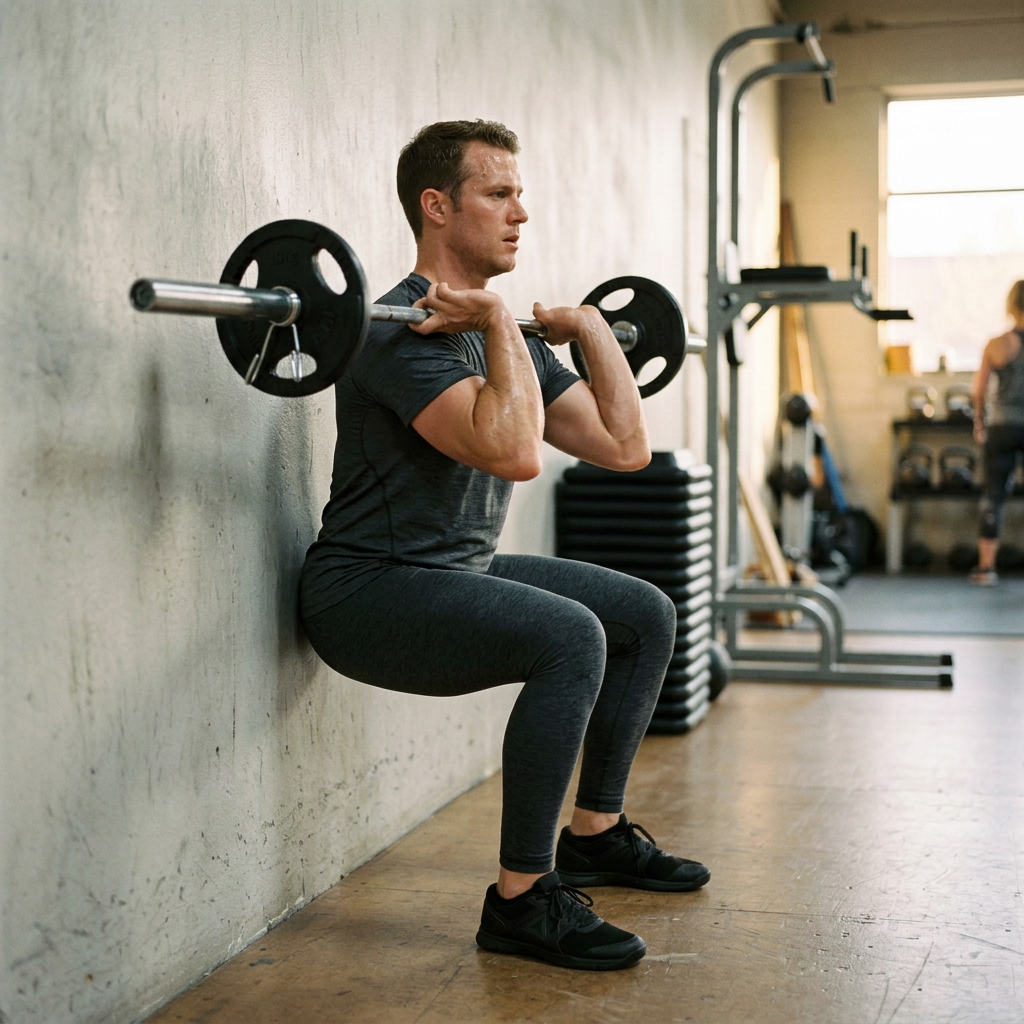
- Yielding Isometrics: Holding a load or position against gravity to prevent movement (e.g., maintaining a wall sit, holding a squat position at 90 degrees or supporting a kettlebell in a static position).
- Overcoming Isometrics: Pushing or pulling against an unyielding, immovable object with maximum effort (e.g., attempting to lift a pin-loaded barbell fixed inside a power rack).
ISO CHAIN:https://amzn.to/4xPmerJ
(Amazon Affiliate)
Section 2: The Key Benefits of Static Training
+--------------------------------------------------------------------------+
|                     CORE ADVANTAGES OF ISOMETRICS                        |
+--------------------------------------------------------------------------+
|  1. Lower Joint Stress     -> Maximizes muscular tension with zero movement |
|  2. Blood Pressure Impact  -> Triggers systemic vascular resistance drops  |
|  3. Angle-Specific Gains   -> Focuses peak force output at sticking points|
|  4. Minimal Equipment      -> Bodyweight, straps, or immovable barriers    |
+--------------------------------------------------------------------------+
- Significant Cardiovascular & Blood Pressure Benefits: Studies indicate that performing regular isometric exercise, particularly wall sits and handgrip holds, can lower resting systolic and diastolic blood pressure.
- Maximum Motor Unit Recruitment: Overcoming isometrics allow you to recruit high-threshold motor units rapidly without suffering the eccentric damage that leads to severe delayed onset muscle soreness (DOMS).
- Targeted Weak-Point Elimination: If you struggle at the sticking point of a bench press or deadlift, performing isometric holds at that precise angle increases neural drive and strength within a $15^\circ$ to $20^\circ$ window around that position.
- Low Impact & Rehabilitation Friendly: Because joint movement is eliminated, isometrics reduce shearing forces on cartilege and connective tissues, making them a cornerstone protocol for joint replacement rehab and tendinopathy recovery.
Section 3: Top 5 Essential Isometric Exercises
Here is a structured overview of five high-yield isometric movements you can easily incorporate into any fitness routine:
| Exercise Name | Primary Target Muscles | Execution Focus | Recommended Hold Time |
| Forearm Plank | Core (Transverse Abdominis, Rectus Abdominis) | Neutral spine, active glute contraction, push elbows into floor. | 30–60 seconds per set |
| Wall Sit | Quadriceps, Glutes | Knees bent at $90^\circ$, back flat against wall, heel pressure. | 45–90 seconds per set |
| Overhead Hold | Shoulders, Upper Back, Core | Lock arms overhead with weight or resistance band, brace core. | 20–40 seconds per set |
| Glute Bridge Hold | Gluteus Maximus, Hamstrings | Drive through heels, full hip extension at top without arching back. | 30–60 seconds per set |
| Isometric Bicep Curl | Biceps Brachii, Brachialis | Contract elbow flexors at $90^\circ$ against an immovable bar or band. | 10–20 seconds (overcoming) |
+--------------------------------------------------------------------------+
|                     ISOMETRIC WALL SIT ALIGNMENT                         |
+--------------------------------------------------------------------------+
|   [Wall]                                                                 |
|     ||                                                                   |
|     ||======= Head & Upper Back Flat Against Wall                        |
|     ||                                                                   |
|     ||---- Hip Angle: 90 Degrees                                         |
|     ||     |                                                             |
|     ||     |--- Thighs Parallel to Ground                               |
|     ||     |                                                             |
|     ||     Knee Angle: 90 Degrees                                        |
|     ||     |                                                             |
|            |--- Feet Flat on Floor (Width: Shoulder-width)               |
+--------------------------------------------------------------------------+
Section 4: How to Program Isometric Holds
Structuring an isometric training session depends entirely on whether your objective is hyper-explosive strength, joint rehabilitation, or muscular endurance.
1. Maximum Strength & Power Protocol (Overcoming Isometrics)
- Intensity: $90\%–100\%$ maximum voluntary effort.
- Duration: 3 to 6 seconds per repetition.
- Sets: 3 to 5 sets per joint angle.
- Rest: 120 to 180 seconds between sets to allow central nervous system recovery.
2. Hypertrophy & Muscular Endurance Protocol (Yielding Isometrics)
- Intensity: $60\%–75\%$ effort or bodyweight holds.
- Duration: 30 to 60 seconds per hold.
- Sets: 3 to 4 sets per exercise.
- Rest: 60 seconds between sets.
+--------------------------------------------------------------------------+
|                    WEEKLY ISOMETRIC INTEGRATION SAMPLE                   |
+--------------------------------------------------------------------------+
|  DAY 1: Upper Body + Overcoming Pressing (Power Rack Holds)              |
|  DAY 2: Lower Body + Yielding Wall Sits & Glute Bridge Holds           |
|  DAY 3: Active Recovery + Core Planks & Isometric Stretch Holds        |
+--------------------------------------------------------------------------+
Section 5: Common Mistakes and How to Avoid Them
- Holding Your Breath (Valsalva Maneuver): Contracting hard without moving often leads people to hold their breath involuntarily, causing sharp increases in intracranial and arterial pressure. Practice steady, rhythmic breathing throughout every static hold.
- Neglecting Joint Angles: Because isometric strength gains are angle-specific, training at only one position (e.g., $90^\circ$ elbow flexion) limits performance across the full range. Vary your joint angles across multiple sets (e.g., deep, mid-range, and near-extended positions).
- Poor Postural Alignment: Static positions lock in movement patterns. Ensuring proper spinal alignment during exercises like planks or wall sits prevents compensatory strain.
ISO CHAIN AVAILABLE HERE:https://amzn.to/4xPmerJ
Unlock Maximum Strength in Minutes: The Ultimate Guide to Isometric Chain Training
In a world where busy schedules often derail fitness routines, the traditional model of spending hours in the gym pushing heavy iron is rapidly evolving. Imagine achieving maximal muscle activation, rapid strength gains, and enhanced joint health without spending hours lifting weights or suffering through grueling recovery periods. Enter static strength training via the EAS1SOOPE Isochain Device.
The Science Behind Isometric Strength Training
Unlike isotonic exercises—where muscles lengthen and shorten under tension (such as dynamic barbell deadlifts or dumbbell bicep curls)—isometric exercises involve exerting force against an immovable object. Because your joint angle and muscle length do not change during a rep, your neuromuscular system is forced to recruit high-threshold motor units almost instantly.
Research shows that maximal isometric contractions can recruit up to 15% more muscle fiber units than standard dynamic lifting. When pulling as hard as possible against an immovable force, your body undergoes deep central nervous system conditioning without the associated shear stress and wear-and-tear on your joints.
What Makes This Tool Different?
The EAS1SOOPE Static Training Device is engineered to make high-intensity static holds accessible and comfortable:
- Symmetrical Design for Ideal Biomechanics: Featuring a 20-inch baseplate and a 20-inch handle, it provides optimal leverage and foot-position stability across various movements.
- Heavy-Duty Construction: Built with durable Acrylonitrile Butadiene Styrene (ABS) components alongside steel chain tensioners.
- Ergonomic Handling: Equipped with a medium-sized, rubberized grip to protect your hands during high-force pulls and presses.
- Fully Adjustable Linkage: The steel adjustment chain lets you instantly modify the height and stretch angle for deadlifts, bicep curls, overhead presses, and bent-over rows.
Key Benefits of Static Workouts
1. Rapid Workouts with Maximum Force Output
Because isometric efforts trigger intense neuromuscular adaptation in 6-to-10-second bursts, complete full-body workouts can be executed in under 15 minutes.
2. Zero Joint Impact and Reduced Soreness
Traditional weight training inflicts muscle micro-tears primarily during the eccentric (lowering) phase. Isometric holds eliminate eccentric stress, allowing you to train harder without delayed onset muscle soreness (DOMS).
3. Total Portability
Weighing a fraction of a barbell or dumbbell set, this self-contained trainer delivers hundreds of pounds of resistance anywhere—from home offices to hotel rooms.
Complete Full-Body Isometric Workout Routine
Perform each isometric exercise by adjusting the chain to the target position. Exert maximum force against the immovable handle for 6 seconds per effort, resting 30 seconds between repetitions.
| Exercise | Primary Muscle Group | Setup Tip |
| Isometric Deadlift | Glutes, Hamstrings, Lower Back | Stand on baseplate, adjust chain to mid-shin height, and pull upward with a flat back. |
| Static Overhead Press | Shoulders, Triceps | Step on baseplate, set handle at collarbone height, and push upward overhead. |
| Isometric Bicep Curl | Biceps, Forearms | Set handle at 90-degree elbow bend and flex upward with maximum intent. |
| Bent-Over ISO Row | Lats, Rhomboids, Rear Delts | Hinge at hips, grip handle at knee height, and pull backward into your torso. |
Final Thoughts
Whether you are looking to break through strength plateaus, protect aging joints, or simply stay fit with a high-efficiency home workout system, isometric chain training offers a scientifically validated pathway to elite strength gains.
